Let's Search
Please enter keywords...
Website Design Copyright©2026 ADDA Corporation. All Rights Reserved.
Executive Summary
ADDA provides comprehensive technical support for thermal management solutions. This guide is designed to assist engineers in optimizing fan selection and system design. Key topics include P-Q characteristic curve interpretation, compliance with international testing standards (AMCA 210 / ISO 5801), unit conversion, and design recommendations for series and parallel fan configurations.
ADDA's performance testing laboratory strictly adheres to globally recognized testing protocols to ensure the highest level of data integrity and reliability for every fan. Built in accordance with AMCA 210-99 standards, our wind tunnel testing system provides engineers with the trustworthy ba
The test fan is mounted at the intake of the wind tunnel, where air is drawn through calibrated nozzles into the test chamber. The system measures the precise airflow (Q) and static pressure (P) at multiple points within the flow field. This data is then processed to generate the P-Q Characteristic Curve, representing the fan's overall performance profile.
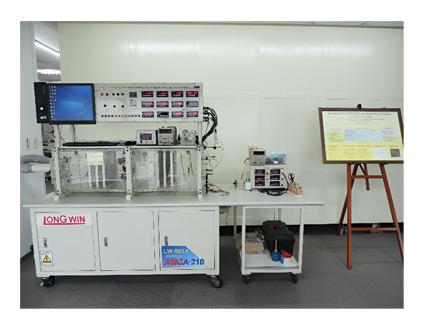
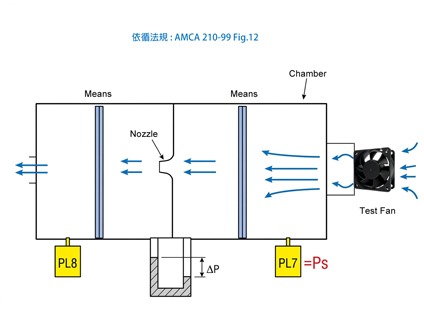
ADDA utilizes AMCA 210 and ISO 5801 as our primary laboratory testing standards. While issued by different regulatory bodies, these standards are technically equivalent in methodology, ensuring our fan performance data aligns with major global market specifications.
Standards Cross-Reference Table
Organization |
Standard No. |
Region / Country |
|---|---|---|
| AMCA | 210-99 | USA (Adopted by ADDA |
| ISO | 5801-1997 | International Standard |
| BS | 848 | United Kingdom |
| DIN | 24163 | Germany |
| GB/T | 1236-2000 | China |
| JIS | B 8330-1981 | Japan |
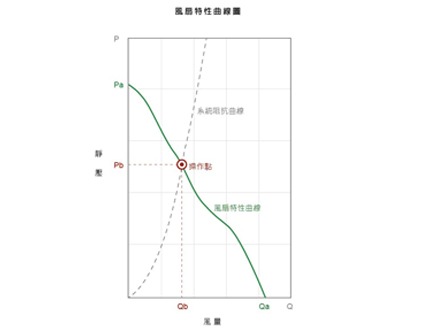
■ Static Pressure(P):The capacity to overcome system resistance, represented on the Y-axis.
■ Air Flow(Q):The volume of air moved per unit of time, represented on the X-axis.
■ System Impedance Curve:This represents the resistance to airflow within the device enclosure (indicated by the dashed line in the diagram).
■ Operating Point:The intersection of the Fan Performance Curve and the System Impedance Curve (denoted as Pb, Qb). This point defines the actual performance efficiency of the fan within that specific system.
⚠️ Design Tip:If the operating point falls within the "Stall Region" (the high-pressure area on the upper left), it may lead to increased acoustic noise and airflow instability. It is highly recommended to select a fan model where the operating point resides within the stable, linear mid-section of the curve.
| Abbr. | Full Name | Unit Definition |
|---|---|---|
| CFM | Cubic Feet Per Minute | ft³/min |
| CMM | Cubic Meter Per Minute | m³/min |
| CMH | Cubic Meter Per Hour | m³/h |
| L/s | Liter Per Second | L/s |
| Unit | Conversion Relationship | Notes |
|---|---|---|
| Pa(Pascal) | 1 Pa = 1 N/m² | SI International Standard |
| mmAq(mmH₂O) | 1 mmAq ≈ 9.8 Pa | 1 mmAq ≈ 1 kg/m² |
| inchH₂O | 1 inchH₂O = 25.4 mmAq | Imperial / U.S. Customary Unit |
Frequently Asked Questions
Series & Parallel Configurations · Standard Air Conditions · Selection Guidelines
⛔ Official Recommendation: Not Recommended.
While theoretically connecting fans in series can increase static pressure, in practical applications, it often leads to airflow turbulence and significant loss of motor efficiency. For optimal reliability and performance, ADDA does not recommend deploying fans in a series configuration.
When two fans are operated in parallel, the total airflow (Q) is effectively increased, provided the system has low impedance (low resistance). However, the maximum static pressure (P) remains the same as a single fan. This configuration is ideal for open-chassis systems or applications requiring high-volume cooling with minimal backpressure.
When interpreting test data, it is essential to distinguish between the following two air conditions, as airflow performance varies ba
| Condition | Temperature | Barometric Pressur | Relative Humidity | Air Density |
|---|---|---|---|---|
| Standard Air | 20°C | 760 mmHg | 65% | 1.2 kg/m³ |
| Normal Air | 0°C | 760 mmHg | 0% | 1.293 kg/m³ |
In compliance with EU personal data protection laws, we are committed to protecting and providing you with control over your personal data. By clicking "Accept All", you allow us to place cookies to enhance your experience on this site, help us analyze site performance and usage, and enable us to deliver relevant marketing content. You can manage your cookie settings below. By clicking "Agree" you agree to the current settings. For more information, please visit the Privacy Statement.
This website uses cookies
In compliance with EU personal data protection laws, we are committed to protecting your personal data and providing you with control over it. By clicking "Agree", you allow us to place cookies to improve your experience on this site, help us analyze site performance and usage, and allow us to deliver relevant marketing content.
By clicking "Only necessary" you allow us to place only necessary cookies. The website cannot function without these cookies and you cannot switch them off on your system. These cookies are typically set only in response to an action you perform (i.e. a service request), such as setting privacy preferences, logging in, or filling in a form. You can set your browser to block or prompt you for these cookies, but this may prevent some site features from working.