Let's Search
Please enter keywords...
Website Design Copyright©2026 ADDA Corporation. All Rights Reserved.
2026
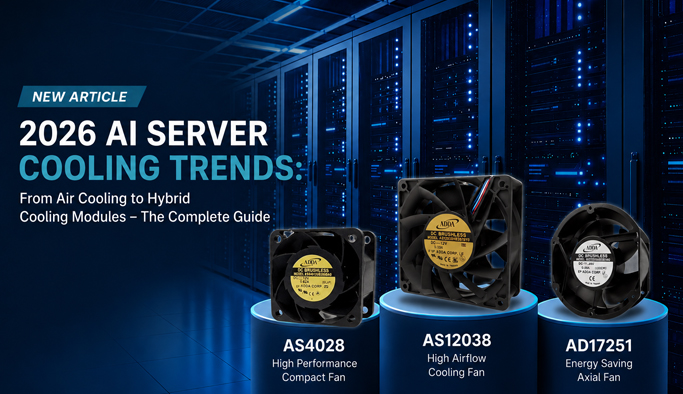
With the rapid growth of large language models and generative AI, data centers worldwide are facing an unprecedented increase in computing power. While we admire the breakthroughs enabled by AI, we often overlook the severe challenge taking place deep inside server rooms: a growing thermal crisis.
The power consumption of next-generation AI chips, such as high-end GPUs, has already exceeded 1,000W and continues to rise. In such an extreme environment, traditional cooling methods can no longer support the system alone. This is no longer only a temperature issue; it is a strategic concern directly related to system stability, energy consumption measured by PUE, and overall operating costs.
In today’s market, cooling has evolved from a supporting component into core infrastructure that determines the upper limit of computing performance.
To understand future trends, we first need to understand how server cooling has developed. Server thermal architecture is undergoing a significant transformation.
For many years, data centers primarily relied on air cooling. Powerful computer room air conditioning units (CRAC) delivered cold air through raised floors, while server fans drew cool air in and exhausted hot air out. This approach offered low installation costs and mature technology, making it sufficient for earlier generations of general-purpose servers.
However, as we enter the AI era, the power density of a single rack has risen sharply from around 5kW in the past to 50kW, or even more than 100kW. The heat-transfer efficiency of air, or its specific heat capacity, can no longer remove such a large amount of heat quickly enough. As a result, liquid cooling technologies, especially cold plates and immersion cooling, are becoming mainstream.
It is important to note, however, that the adoption of liquid cooling does not mean fans will disappear; instead, their role is being upgraded. In hybrid cooling architectures, and in the key equipment that keeps liquid cooling systems running, high-performance cooling fans still play an irreplaceable role.
(Additional note: Specific heat capacity refers to a material’s ability to absorb heat. Water has approximately four times the specific heat capacity of air, which is why liquids can remove heat much more efficiently than air.)
Ready to upgrade the cooling performance of your data center? Whether you are operating a traditional air-cooled architecture or evaluating the adoption of liquid cooling, our team can provide professional technical support.
► [Click here to schedule a free online consultation with ADDA’s thermal engineering team]
After high-end AI servers are deployed, operations and maintenance teams typically face the following immediate challenges:
Extreme Heat Density and Airflow Resistance: Why Fan Size and Configuration Matter AI servers are packed with dense GPUs, HBM (high-bandwidth memory), and large heat sinks. This creates extremely high system airflow resistance. Fans must not only run at high speed, but also deliver very high static pressure to force airflow through narrow gaps. Ordinary fans may lead to chip overheating and thermal throttling in this type of environment.
Demanding 24/7 Operation and Vibration Control AI computing workloads often run around the clock. If the fan motor is not properly balanced, even small vibrations can shorten service life and may also affect the stability of precision components on the server motherboard.
Pressure from Energy Consumption and ESG Sustainability Targets As data centers pursue highly optimized PUE (Power Usage Effectiveness), reducing fan power consumption while improving cooling performance has become essential for meeting ESG requirements.
Moving Beyond the Myth of Pure Liquid Cooling Many people assume that future data centers will fully shift to pure liquid cooling. In reality, pure liquid cooling requires high installation costs, and the operational downtime risk caused by potential leakage is a major concern. Unless the application involves ultra-large-scale computing power under extreme conditions, pure liquid cooling is not the only, or always the most economical, solution for every data center.
The Rise of Hybrid Cooling Over the next 3 to 5 years, the mainstream technical direction will be hybrid liquid-air cooling. ADDA’s comprehensive thermal modules, integrating high-static-pressure fans, 3D vapor chambers, and heat pipe technology, can work seamlessly with cold plates and CDU (Coolant Distribution Unit) systems.
Core Differences in Heat-Capture Rate
How Does Air Cooling Make Up for the Limits of Liquid Cooling? A Complementary Thermal Strategy
Facing these challenges and diverse system requirements, what capabilities should future cooling fans offer? Using AS12038, ADDA’s next-generation benchmark product developed for 2026, as an example, we can see the profile of a next-generation fan:
Through advanced motor-drive design and optimized blade aerodynamics, next-generation fans must reduce power consumption while increasing rotational speed. Based on our internal test data, the new AS12038 delivers the following improvements compared with the previous model:
AI servers create extremely high airflow resistance, making static pressure a critical performance factor. The new fan increases static pressure by 12.6%, ensuring airflow can penetrate dense internal server structures. At the same time, through precision acoustic design, overall noise does not increase despite the improved performance; instead, it is slightly reduced by 4.0%. This is highly valuable for improving the data center working environment.
|
|
|
|
|
|
|
|
|
|
|
|
|
|
|
|
|
|
|
|
|
|
|
|
|
|
|
|
|
|
|
|
|
|
|
|
|
|
|
|
|
|
(Note: The above figures are based on laboratory testing and are intended to highlight the design concept of maintaining leading operating performance under high-load conditions.)
Need customized fan tuning for your equipment? Our R&D center provides comprehensive customization services, from motor characteristics and blade design to environmental testing.
► [Contact ADDA today to start your dedicated cooling project]
From traditional server rooms to AI data centers, and from simple air cooling to CDU-based hybrid liquid cooling architectures, the evolution of cooling technology has completely changed the face of infrastructure. In this process, cooling fans are no longer standardized components; they have become highly customized strategic parts that require precise calculation.
We understand that stability is the highest standard. Since its establishment in 1978, ADDA Corporation has become a sustainable thermal ecosystem partner behind many global brands, supported by a global team of more than 1,000 employees, a solid production scale of 25 million units shipped annually, and decades of patented thermal technologies.
Looking ahead to the rapid expansion of AI computing, you need more than a component supplier. You need a strategic partner that understands system architecture, has extreme testing capabilities, and can provide comprehensive solutions. We are ready to work with you to drive innovation and realize the future.
Q1: After AI servers adopt liquid cooling technology, are cooling fans still needed?
A1: Yes, absolutely. Most data centers today use a hybrid liquid-air cooling architecture. Even when cold plates remove 70%–80% of the heat from CPUs/GPUs, peripheral components on the motherboard, such as memory (HBM), network cards, and power modules (VRM), still require high-pressure fans for air cooling to eliminate localized hot spots.
Q2: In a hybrid cooling architecture, what are the most important specifications for cooling fans?
A2: The most critical specifications are high static pressure and high airflow. Fans must push air through dense server components, quick-connect piping, and high-resistance heat sinks, forcing airflow through narrow gaps and effectively exhausting residual heat from inside the system.
Q3: What customized thermal services can ADDA provide?
A3: We provide comprehensive integrated thermal solutions. From early-stage system resistance evaluation and thermal-flow simulation, to blade aerodynamic design, motor energy-saving optimization, and later-stage extreme environmental testing, such as thermal shock testing, we can tailor the most suitable fans and thermal modules for your specific server architecture.
Q4: Under the ESG trend, how can cooling fans help companies achieve their targets?
A4: By optimizing motor design and fluid dynamics, next-generation fans can significantly reduce current and power consumption while improving cooling performance, including high speed and high static pressure. For example, ADDA’s new fan can reduce power consumption by nearly 20%. This directly helps data centers lower overall electricity usage, optimize PUE, and achieve corporate sustainability goals for energy saving and carbon reduction.
Bring your cooling challenges to us. Do not let thermal limitations become the bottleneck of your computing-power growth. Our engineering team is ready to support you.
► [Visit ADDA’s official website / Fill out the online consultation form]
In compliance with EU personal data protection laws, we are committed to protecting and providing you with control over your personal data. By clicking "Accept All", you allow us to place cookies to enhance your experience on this site, help us analyze site performance and usage, and enable us to deliver relevant marketing content. You can manage your cookie settings below. By clicking "Agree" you agree to the current settings. For more information, please visit the Privacy Statement.
This website uses cookies
In compliance with EU personal data protection laws, we are committed to protecting your personal data and providing you with control over it. By clicking "Agree", you allow us to place cookies to improve your experience on this site, help us analyze site performance and usage, and allow us to deliver relevant marketing content.
By clicking "Only necessary" you allow us to place only necessary cookies. The website cannot function without these cookies and you cannot switch them off on your system. These cookies are typically set only in response to an action you perform (i.e. a service request), such as setting privacy preferences, logging in, or filling in a form. You can set your browser to block or prompt you for these cookies, but this may prevent some site features from working.