⚡ 1-Minute Summary
A cooling fan's service life (L₁₀) and noise performance depend largely on its bearing design. FDB and Maglev bearings can offer performance advantages, but their higher costs may not be justified for every industrial application. Likewise, choosing high-end bearings for standard, low-temperature environments may add unnecessary costs. This guide compares Sleeve Bearings, Dual Ball Bearings, Fluid Dynamic Bearings (FDB), and Maglev Bearings in terms of operating temperature, mounting orientation, and service-life requirements. It also presents a practical five-step selection process to help R&D and procurement teams evaluate suitable bearing solutions, including industrial-grade dual ball bearings and enhanced sleeve bearings, for their applications.
1. Bearing Technology: The Core Factor in Fan Lifespan and System Reliability
The bearing is a critical component in a cooling fan's rotation system, supporting the shaft and keeping the impeller running steadily. Its structural design, lubrication characteristics, and load capacity directly affect fan efficiency, noise performance, and service life. Especially in industrial equipment, servers, and other long-running applications, bearing reliability is a key factor in overall cooling system stability.
When designing a cooling system, engineers usually focus on performance metrics such as airflow (CFM), static pressure (mmH₂O), and rotational speed (RPM). However, if load capacity, lubrication stability, and the actual operating environment are overlooked, even a fan with good initial airflow performance can suffer from bearing wear or lubricant degradation over long-term operation—leading to increased noise, abnormal vibration, or disrupted equipment operation.
Three common causes of early bearing failure in the field include:
- High-Temperature Oil Evaporation and Oxidation: When internal enclosure temperatures exceed the lubricant's operating limit, lubrication breaks down and causes metal-to-metal dry friction.
- Gravity-Induced Uneven Wear: In non-horizontal installations, the rotating shaft continuously presses against one side of the sleeve inner wall, distorting geometric tolerances and disrupting dynamic balance.
- Structural Vibration Fatigue: High-speed (High RPM) operation can induce high-frequency resonance, accelerating mechanical fatigue and causing operating noise to spike.
Therefore, cooling fan bearing selection should not rely on a single performance metric. Engineers should evaluate operating temperature, operating hours, mounting orientation, noise requirements, and total cost together. Each bearing technology has its own suitable range, and evaluating them based on actual equipment needs is essential to balance cooling performance, service life, and cost.
2. Bearing Operating Principles and Characteristics
Cooling fan performance depends not only on airflow, static pressure, and speed—the bearing system is equally critical to service life, noise, and reliability. Different bearing structures directly affect friction characteristics, heat resistance, mounting orientation, and long-term operation. Common cooling fan bearing technologies include Sleeve Bearings, Dual Ball Bearings, as well as Maglev and Fluid Dynamic Bearing (FDB) technologies. Each structure has distinct operating principles and suitable conditions that must be evaluated based on the equipment's operating environment and practical requirements.
Key Point 1: Sleeve Bearing | Cost-Effective & Practical
Operating Principle:
A sleeve bearing is a sliding bearing composed mainly of a shaft, a porous sintered metal sleeve, and lubricating oil. Tiny pores inside the sleeve store lubricating oil; when the fan runs, the oil forms a lubricating film between the shaft and the sleeve to reduce contact friction and mechanical wear.
This type of bearing has a relatively simple structure and mature manufacturing technology, making it widely used in general cooling fans. Its operating performance is closely related to oil viscosity, operating temperature, and bearing clearance.
Key Technical Characteristics:
- Low Manufacturing Cost: Simple structure and fewer parts provide a clear cost advantage, suitable for mass production and price-sensitive applications.
- Low Operating Noise: When well-lubricated, sliding contact delivers smooth operation suitable for general electronic equipment with noise requirements.
- Restricted Mounting Orientation: Affected by gravity and oil distribution, some designs are sensitive to mounting angle and usually require selecting an appropriate installation orientation according to product specifications.
【ADDA Patented Product: Hypro Bearing Fluid Protection System】
To overcome the inherent oil leakage and shorter lifespan of traditional sleeve bearings, ADDA developed its patented Hypro Bearing. This technology introduces a closed-loop dynamic oil circulation system and micro oil-guiding grooves inside the bearing. During fan rotation, hydrodynamic pressure drives the lubricating oil to circulate continuously, blocking oil leakage paths and preventing high-temperature evaporation.
- Extended Service Life: Under normal operating conditions (40°C), its expected L₁₀ service life reaches over 50,000 hours.
Operating Environment and Applications:
Sleeve bearings are suitable for normal operating temperatures, non-continuous operation, and cost-effective cooling applications. They are commonly used in consumer electronics, desktop computers, office equipment, and general home appliances. If the application involves higher temperatures, long-term continuous operation, or special mounting orientations, lubrication stability and expected service life should be evaluated further to prevent operating conditions from exceeding design limits and affecting fan reliability.
Key Point 2: Dual Ball Bearing | Heat-Resistant & Built for Long-Term Operation
Operating Principle:
Dual ball bearings use two sets of precision steel balls to support the rotating shaft. As the balls roll between the inner and outer rings, they reduce friction resistance and provide stable shaft support. Compared with sleeve bearings that rely on an oil film, dual ball bearings carry operating loads mainly through rolling contact and are much less sensitive to mounting orientation. Combined with appropriate bearing precision, grease, and sealing design, they meet the demands of higher temperatures and long-term continuous operation.
Key Technical Characteristics:
- Good Heat Resistance: With appropriate bearing materials and grease design, dual ball bearings can be used in higher-temperature operating environments. Actual upper temperature limits should be confirmed against product specifications.
- Multi-Directional Mounting Support: Ball bearings offer good installation flexibility and can be configured horizontally, vertically, or in other orientations according to equipment structure.
- Suitable for Long-Term Operation: The precision rolling structure helps reduce friction, making it ideal for industrial and electronic equipment requiring long-term continuous operation.
Operating Environment and Applications:
Dual ball bearings are suitable for equipment operating in high temperatures, running for long periods, or requiring complex mounting orientations—such as servers, telecom base stations, industrial automation equipment, automotive electronics, and energy storage systems. For equipment that must maintain cooling capability over long periods, bearing heat resistance and operational reliability are particularly important. During selection, alongside expected service life, engineers should also evaluate noise, load, and maintenance requirements to ensure the overall cooling system meets design specifications.
Key Point 3: Specialized Bearing Technologies (FDB / Maglev) | Fluid Dynamic & Magnetic Support
Operating Principle:
Fluid Dynamic Bearings (FDB) and Maglev Bearings are two distinct specialized support technologies that use fluid dynamics and magnetic force, respectively, to support the rotating shaft and improve friction, vibration, or noise performance under specific conditions. FDB uses a dynamic oil film generated during shaft rotation to build load-carrying pressure that supports the shaft in operation; maglev bearings use magnetic fields to generate support force, keeping rotating components in a non-contact or low-contact state under specific design conditions. While their operating principles and structural designs differ, both require careful consideration of precision, materials, manufacturing cost, and actual operating environments.
Key Technical Characteristics:
- Fluid Dynamic Bearing (FDB): Reduces direct contact between the shaft and bearing surface through a dynamic oil film; design priorities focus on oil film stability, lubricant properties, and precision machining.
- Maglev Bearing: Uses magnetic force to support rotating components and reduce friction caused by mechanical contact, though actual structures and control methods vary by design.
- High Precision Design Requirements: FDB requires precise control over the oil film and sealing structure, while maglev bearings involve design factors such as magnetic circuits, positioning, and support stability.
- Cost and Integration Considerations: Specialized structures usually involve higher manufacturing or system integration requirements, so their actual benefits must be evaluated based on equipment application conditions and overall cost.
Operating Environment and Applications:
FDB and maglev bearings are mainly used in specialized equipment with higher requirements for operating noise, vibration, and precision, such as high-end medical instruments, precision testing equipment, and certain specialized industrial systems. Although these technologies offer advantages in specific applications, their precision structures and higher manufacturing costs also limit their use depending on equipment needs and cost-effectiveness. For most electronic and industrial cooling applications, Sleeve Bearings and Dual Ball Bearings remain the mainstream choices capable of meeting most cooling needs thanks to their mature technology, stable operating performance, and distinct cost advantages.
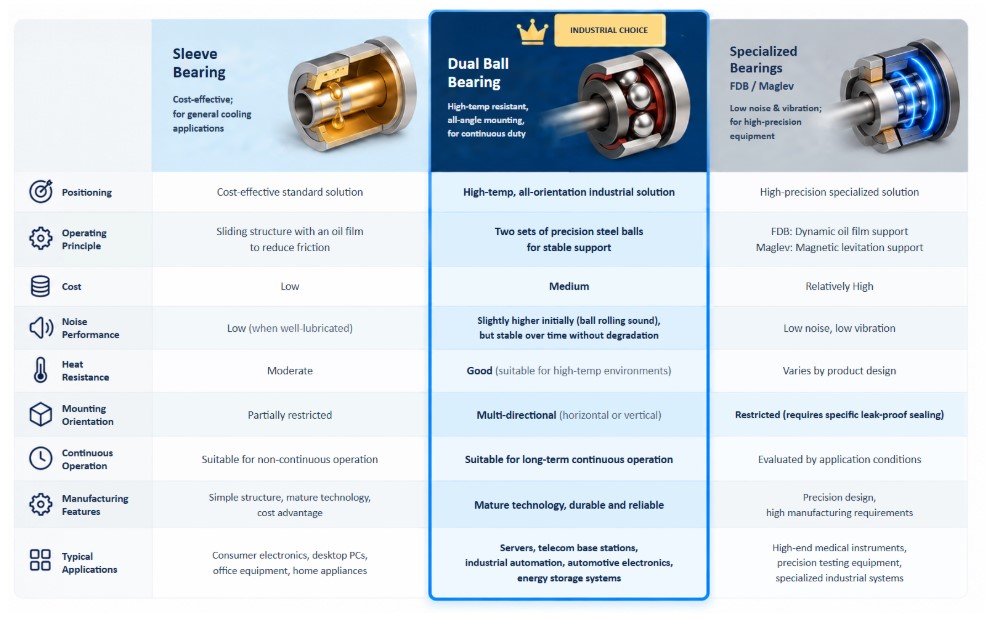
3. Bearing Specification Comparison Table
Engineers can compare the core indicators of the main bearing technologies below based on operating temperature range, mounting orientation, design life, and material budget to confirm procurement direction:
4. Bearing Selection: The 5-Step Evaluation Process
Bearing architecture must be evaluated together with the cooling fan's P-Q performance curve (airflow and static pressure characteristics) to avoid pairing a high-performance impeller with a low-grade bearing, which creates an early mechanical lifespan bottleneck. ADDA recommends following a 5-step decision process:
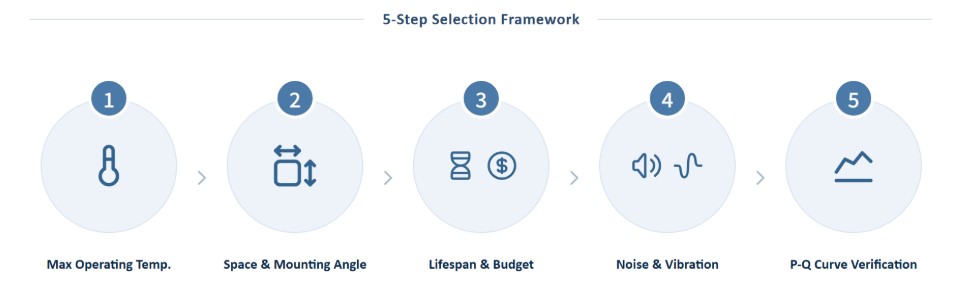
Step 1: Confirm Maximum Operating Temperature and Environmental Conditions
Measure the fan ambient intake temperature after internal heat accumulation inside the system. If the ambient temperature remains above 50°C over long periods, rule out sleeve bearings immediately and specify dual ball bearings with heat-resistant synthetic grease to prevent high-temperature carbonization failure.
Step 2: Define Mechanical Space and Fan Mounting Angle
Confirm the fan's physical orientation inside the enclosure. If the fan is not placed horizontally (such as vertical side-blowing, 45-degree angled airflow, or ceiling-mounted downward blowing), do not use standard sleeve bearings; select dual ball bearings that support 360-degree all-angle operation or specialized bearings with an enhanced circulation loop.
Step 3: Set Target System Lifespan (L₁₀) and Material Cost Limits
Set the fan's L₁₀ lifespan threshold based on product warranty terms. Consumer equipment with a 3-year warranty operating in mild environments can use specialized sleeve bearings for the highest cost advantage; enterprise systems operating 24/7 for five years or more should select dual ball bearings to achieve the best return on investment (ROI).
Step 4: Evaluate Acoustic Environment and Structural Vibration Limits
Analyze the noise specifications of the product operating environment. Server rooms and industrial control cabinets prioritize cooling efficiency and mechanical strength, where dual ball bearings offer high reliability; if desktop equipment has specific initial acoustic limits, PWM speed control curves can be used to suppress ball resonance noise without blindly upgrading to expensive specialized bearings.
Step 5: Verify the System Operating Point with the P-Q Curve
After selecting the bearing technology, compare the fan's static pressure-airflow curve (P-Q Curve) against system airflow impedance. Confirm that under the target operating speed and pressure load, the bearing's mechanical stress margin still meets engineering safety factor standards.
5. Frequently Asked Questions (FAQ)
Can a sleeve bearing fan be mounted vertically or upside down in equipment?
Vertical or inverted installation is generally not recommended for standard sleeve bearing fans. Because sleeve bearings rely on a capillary oil film to support rotation, vertical or inverted mounting allows gravity to pull lubricating oil downward, causing dry friction, uneven wear, and abnormal temperature rise. If the mechanical design requires inverted mounting, specifying an ADDA Dual Ball Bearing fan is recommended to ensure reliability.
Why are dual ball bearings still the mainstream choice for industrial control systems and servers?
Dual ball bearings offer irreplaceable engineering advantages in heat resistance, all-angle mounting flexibility, and total cost of ownership (TCO). Compared with the high machining cost and structural limits of FDB, dual ball bearings can maintain a stable service life of over 50,000 hours in enclosed chassis at 70°C to 85°C. With strong mechanical shock resistance and mature mass-production yields, they are the optimal solution for balancing procurement budgets with long-term, zero-downtime operation in mission-critical systems.
What is the difference between a sleeve bearing and a dual ball bearing?
Sleeve bearings use lubricating oil to form a friction-reducing oil film for cost-sensitive applications at normal temperatures, whereas dual ball bearings use rolling steel balls for superior heat resistance, mounting flexibility, and 24/7 continuous operation. Sleeve bearings feature a simple structure, low manufacturing cost, and practical value for general-temperature, cost-oriented cooling designs. Dual ball bearings reduce friction through rolling balls and provide better heat resistance, installation flexibility, and long-term operating capability for high-temperature and continuous-duty equipment.
How do I choose the right cooling fan bearing?
Bearing selection should evaluate the following five factors together:
- Operating Temperature: Confirm the equipment's actual operating temperature and the bearing's rated temperature range.
- Operating Hours: Evaluate whether the equipment runs intermittently or requires 24/7 long-term continuous operation.
- Mounting Orientation: Verify whether horizontal, vertical, or other mounting orientations match the bearing specifications.
- Reliability Requirements: Choose an appropriate bearing based on equipment criticality, expected service life, and maintenance frequency.
- Procurement Cost: Evaluate product price and total cost of ownership while meeting performance and reliability requirements.
For general cooling needs, sleeve bearings can be evaluated first; if the application involves high temperatures, long-term operation, or multi-directional mounting, dual ball bearings should be considered.
Are FDB and maglev bearings suitable for all cooling fans?
Not necessarily. FDB mainly uses hydrodynamic pressure to form a supporting oil film, while maglev bearings use magnetic force to support rotating components. Each has distinct technical characteristics and is mainly applied in equipment with specific low-noise, precision, or non-contact operating requirements. However, these technologies typically involve higher manufacturing costs and design complexity, so not all cooling applications gain corresponding benefits from them. For general electronic and industrial cooling equipment, sleeve bearings or dual ball bearings can still be evaluated first.