Let's Search
Please enter keywords...
Website Design Copyright©2026 ADDA Corporation. All Rights Reserved.
2026
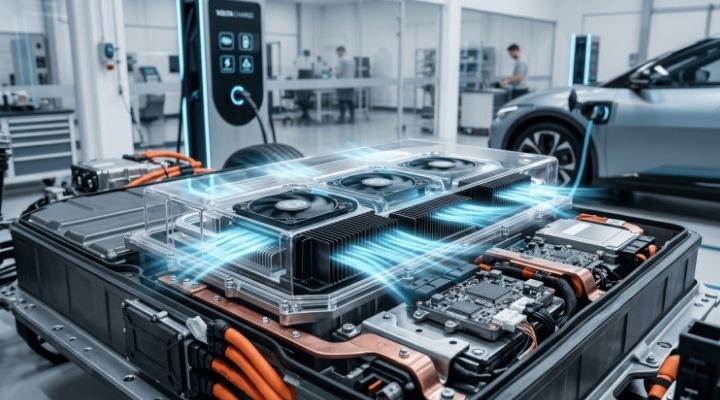
EV Thermal Management Trends in 30 Seconds
As electric vehicle technology advances, thermal management is no longer simply a protective measure—it directly affects driving range, charging performance, system reliability, and vehicle safety. As EV platforms transition to 800 V architectures and autonomous driving controllers approach server-class computing power, conventional cooling methods are reaching their limits.
The future of EV thermal management is being shaped by three priorities: high-efficiency thermal control, automotive-grade reliability in harsh environments, and ultra-quiet cabin performance.
The transition from internal combustion engines to electric powertrains has fundamentally changed how heat is generated and managed. Instead of relying primarily on engine coolant and radiator airflow, EVs must dissipate heat from densely integrated components, including battery packs, traction motors, power electronics, and high-performance processors.
Localized overheating—or thermal hotspots—can cause performance throttling, reduce component life, and, in severe cases, affect vehicle safety. Conventional single-point, passive cooling strategies are therefore no longer sufficient for today’s high-power, high-density EV systems.
Modern electric vehicles are also expected to support rapid DC charging, uninterrupted autonomous driving computation, and a quiet, premium cabin experience. Meeting these demands requires a full-system, active thermal management approach that combines high static pressure, vibration-resistant construction, and acoustic optimization.
• High static pressure: Enables cooling fans to overcome airflow resistance created by densely packed electronic components and restricted air passages, ensuring sufficient airflow reaches power devices, battery modules, and heat sinks.
• Acoustic optimization: Fan blade geometry, motor control, and drive waveforms can be tuned to reduce tonal noise and operating noise, helping maintain the quiet cabin environment expected from vehicles without engine noise.
Need reliable cooling for automotive electronics and EV charging systems under demanding operating conditions? ADDA provides integrated thermal simulation and customized cooling solutions to support your application from design evaluation through product development.
►【 Talk to ADDA’s thermal management specialists about a custom cooling solution 】
Managing High Compute Loads in Autonomous Driving Controllers
Modern electric vehicles integrate high-performance autonomous driving controllers and smart cockpit computing platforms. Processing real-time data from multiple sensors and cameras requires substantial computing power, driving up processor power consumption and heat density to levels comparable to industrial servers.
Within the confined space of a vehicle, heat must be removed from these processors quickly and efficiently. Otherwise, thermal protection mechanisms may trigger performance throttling—an unacceptable risk for safety-critical autonomous driving functions.
Automotive electronics cooling requires more than effective heat dissipation. Cooling components must also meet stringent automotive environmental and reliability requirements, including:
• Reliable operation across extreme temperatures from −40°C to +105°C or higher
• Resistance to high-frequency vibration and mechanical shock during vehicle operation
• Compliance with strict electromagnetic compatibility (EMC) and electromagnetic interference requirements
• Stable fan operation without disrupting in-vehicle wireless communications or onboard electronic systems.
To address these challenges, ADDA incorporates advanced engineering technologies into its automotive cooling solutions:
• Structural modal analysis: Professional simulation tools are used to accurately predict the natural frequencies and vibration modes of individual components. Fan operating speeds can then be optimized to avoid resonance, improving vibration resistance and overall structural durability.
• High-strength integrated locking technology: Developed for long-term automotive operation, this robust mechanical design helps the fan maintain consistent performance and structural integrity under demanding road and vibration conditions.
Recommended Cooling Fan Specifications for Automotive Electronics
For compact vehicle installations and high-impedance airflow environments, ADDA is introducing an upgraded centrifugal blower series in 2026, engineered to deliver high cooling performance within limited installation space:
|
|
|
|
|
|
|
|
|
|
|
|
|
|
|
Whether your project requires a highly customized automotive cooling module or comprehensive PPAP documentation aligned with IATF 16949 requirements, ADDA can provide complete test data and validation reports to help streamline product development and accelerate time to market.
►【Explore ADDA automotive cooling fans and customized thermal solutions】
As EV battery capacity continues to increase, demand for ultra-fast DC charging is growing rapidly. When charging output rises from 50 kW to 350 kW or higher, power conversion systems, inverters, and power supply modules generate substantial heat while handling high electrical currents.
Without an effective EV charging station cooling system to remove this heat promptly, the charger may automatically reduce its output power to prevent overheating. This can extend charging times and, in more severe cases, cause the charging system to shut down.
EV charging stations operate year-round in demanding outdoor environments, where they may be exposed to coastal salt mist, desert dust, heavy tropical rainfall, and prolonged high temperatures. Cooling fans used in charging infrastructure therefore require automotive- and industrial-grade environmental protection.
ADDA’s comprehensive thermal protection technologies are engineered for reliable operation under harsh outdoor conditions:
【ADDA Protection Process for Extreme Outdoor Cooling Applications】
UV protective coating / Parylene coating → Complete motor potting and encapsulation → GR-487 salt spray and IP68 testing → More than 20% longer equipment maintenance intervals
To overcome the high airflow resistance created by densely packed power modules and outdoor charging infrastructure, ADDA offers a new generation of large-frame, high-static-pressure cooling fans:
ADDA has helped leading international energy storage and inverter manufacturers optimize airflow and reduce system impedance. These solutions have enabled systems to maintain 99% conversion efficiency without thermal derating in high-temperature outdoor environments, supporting successful deployment across the Middle East and Taiwan’s Orchid Island.
►【Contact ADDA for high-temperature cooling solutions for EV charging and energy storage systems】
The battery module is the heart of an electric vehicle’s driving range and performance. During charging and discharging, battery temperature should be maintained within an optimal range of approximately 20°C to 40°C. Low temperatures reduce electrochemical activity, while excessive heat accelerates battery degradation and may ultimately contribute to thermal runaway.
ADDA’s automotive cooling solutions integrate high-vibration-resistant blowers to create targeted airflow paths for the battery management system (BMS) and EV battery modules.
Beyond the chassis and powertrain, passenger comfort has become an important point of differentiation for modern smart vehicles. ADDA extends its automotive thermal expertise to critical passenger touchpoints, helping automakers deliver a more comfortable and premium in-cabin experience:
【Complete Thermal Solutions for Smart Vehicle Cabins】
Looking to improve cabin comfort and extend EV battery service life in your next-generation vehicle platform? From compact cooling fans to high-airflow blowers, ADDA provides collaborative engineering support for customized automotive applications.
►【Explore ADDA cooling components for a wide range of in-vehicle applications】
For electric vehicle developers, the absence of internal combustion engine noise makes even minor vibrations and airflow disturbances inside the cabin far more noticeable. Components that were previously masked by engine sound can now become prominent sources of unwanted noise.
Automotive cooling fans must therefore achieve more than higher airflow and static pressure. They must also minimize acoustic noise and cogging torque. Balancing thermal performance with low-noise operation has become a critical benchmark of advanced automotive cooling technology.
ADDA combines comprehensive digital transformation with AI-assisted R&D to overcome the physical limitations of conventional cooling fan design:
ADDA goes beyond professional airflow and electromagnetic simulation—we turn engineering innovation into manufacturable cooling solutions and measurable competitive value.
►【Schedule a thermal engineering consultation to optimize your system’s acoustic performance】
In today’s highly competitive green transportation market, selecting a cooling supplier requires more than comparing component prices. Long-term success also depends on the supplier’s engineering expertise, global production flexibility, and ability to maintain a resilient supply chain.
Founded in 1978, ADDA Corporation has nearly five decades of experience in thermal management. With more than 1,000 employees worldwide, an annual production capacity of up to 25 million units, a dedicated R&D center in Taiwan, and four advanced manufacturing facilities, ADDA supports automotive and industrial customers from concept development through mass production.
To address geopolitical uncertainty and supply chain disruption, ADDA operates a global production strategy that combines R&D and engineering in Taiwan with manufacturing capacity in China and Vietnam.
ADDA’s new Vietnam facility, AX FAN, occupies approximately 46,000 m² and currently operates five dedicated production lines with a monthly capacity of 250,000 units. Space has also been reserved for more than ten additional production lines, enabling flexible capacity expansion and scalable support for global customer programs.
To meet the stringent quality requirements of automotive and energy storage applications, ADDA applies rigorous controls throughout every stage of product development—from EVT (Engineering Validation Testing) and DVT (Design Validation Testing) through MP (Mass Production).
Each program follows the core principles of APQP (Advanced Product Quality Planning) and is supported by a complete PPAP (Production Part Approval Process). During manufacturing, ADDA uses statistical process control (SPC) with a target process capability of Cpk > 1.33.
A barcode-based traceability system records the complete production history of every unit, from IQC (Incoming Quality Control) through OQC (Outgoing Quality Control). This disciplined quality framework supports ADDA’s long-term competitiveness in premium automotive markets worldwide.
ADDA’s engineering capabilities have earned long-term strategic partnerships with leading automotive lighting brands, global electric vehicle manufacturers, major solar inverter companies, and top-tier networking and telecommunications providers.
Whether the challenge involves complex electromagnetic compatibility requirements or continuous operation in extreme environments, ADDA provides dependable thermal management support. Our cooling solutions are engineered to complete 720 hours of continuous operation without performance derating under demanding environmental conditions, delivering the reliability required for automotive and mission-critical applications.
【ADDA at a Glance】
Thermal management is the final line of defense in an electric vehicle’s technology ecosystem. Whether your project is at the concept design, thermal simulation, or rapid prototyping stage, ADDA’s integrated thermal management services—including cooling fans, heat pipes, and precision heat sinks—can help shorten development lead times by more than 30%.
►【Partner with ADDA—complete our project inquiry form to begin developing your next thermal solution 】
Automotive cooling fans require significantly higher levels of environmental durability, vibration resistance, electromagnetic compatibility, and operational life.
Standard IT cooling fans typically operate in temperature-controlled indoor environments. Automotive fans—such as those used to cool ADAS controllers—must operate reliably across temperatures from −40°C to +105°C, withstand continuous high-frequency road vibration, and meet stringent EMC requirements without interfering with safety-critical vehicle electronics.
DC fast chargers are often installed outdoors without protective enclosures, leaving them exposed to rain, dust, salt mist, and other environmental contaminants.
IP68-rated cooling fans provide complete protection against dust ingress and sustained water immersion. GR-487-CORE testing evaluates resistance to salt fog and corrosion under demanding outdoor operating conditions. Fans that meet both requirements—such as ADDA’s high-performance blower series—help prevent environmentally induced fan failures and can extend charging equipment maintenance intervals by more than 20%.
Because EVs lack engine noise to mask other sounds, cooling fans must be optimized at both the structural and motor-control levels.
ADDA uses computational fluid dynamics (CFD) to optimize blade airflow paths and angles, reducing turbulence and wind-shear noise. At the motor-control level, next-generation three-phase sinusoidal field-oriented control (FOC) smooths phase-current waveforms and reduces commutation-related vibration. Together, these technologies help minimize motor vibration and operating noise while maintaining the airflow required for reliable cooling.
Yes. ADDA provides integrated, all-in-one thermal management solutions tailored to each application.
Our engineering team combines high-efficiency DC, AC, and EC cooling fans with high-conductivity heat pipes and precision skived-fin heat sinks. Services cover the complete development cycle, including initial CFD thermal and airflow simulation, collaborative mechanical design, rapid prototyping, and reliability testing and validation.
The result is a lighter, more compact integrated cooling module engineered to improve overall thermal efficiency by up to 30%.
In compliance with EU personal data protection laws, we are committed to protecting and providing you with control over your personal data. By clicking "Accept All", you allow us to place cookies to enhance your experience on this site, help us analyze site performance and usage, and enable us to deliver relevant marketing content. You can manage your cookie settings below. By clicking "Agree" you agree to the current settings. For more information, please visit the Privacy Statement.
This website uses cookies
In compliance with EU personal data protection laws, we are committed to protecting your personal data and providing you with control over it. By clicking "Agree", you allow us to place cookies to improve your experience on this site, help us analyze site performance and usage, and allow us to deliver relevant marketing content.
By clicking "Only necessary" you allow us to place only necessary cookies. The website cannot function without these cookies and you cannot switch them off on your system. These cookies are typically set only in response to an action you perform (i.e. a service request), such as setting privacy preferences, logging in, or filling in a form. You can set your browser to block or prompt you for these cookies, but this may prevent some site features from working.